


How to help the housing crisis
Updated: Aug 17

A version of this article originally appeared in The JOLT News.
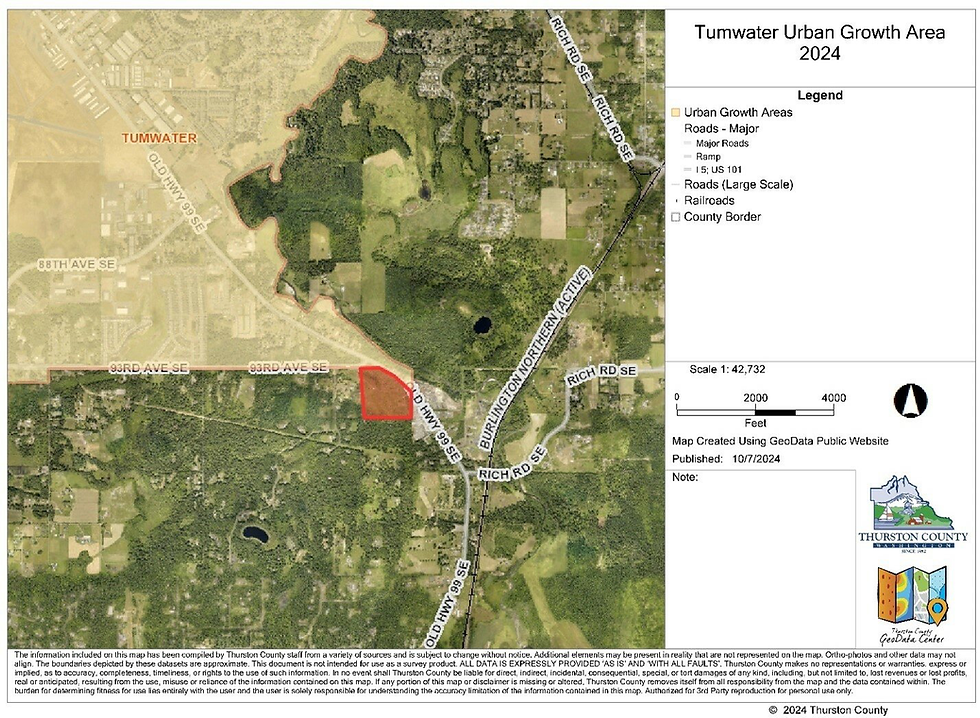
Do you want to help combat the housing crisis? Then you should consider opposing a proposed development called BAR Holdings/Salish Landing at the corner of 93rd Avenue and Old Highway 99.
The proposal does not comply with multiple requirements of a 2024 law called the UGA swap law, and as a result, it will not get built. Even if Thurston County Commissioners were to vote to approve it, the project will get tied up in costly court battles, and the county will be on the hook to pay for that litigation. This effort is shifting resources from housing projects that have a chance of being built.
Even worse, county staff, as well as staff at the City of Tumwater, are now being required to invest a lot of time and energy into this doomed project. These are staff resources that could be spent elsewhere—like on projects that truly would produce housing.
These are your tax dollars being spent. Make your voice heard so that more good money is not thrown after bad.
The development is often framed as an effort to expand housing supply. This is because the narrative being put forth by the Thurston County Chamber of Commerce on behalf of the developers is that this development is needed because of the “housing crisis.” Missing from that narrative are all the reasons why the development cannot get built because it is not legal.
What is a UGA?
“UGA” stands for Urban Growth Area. An Urban Growth Area is like a beltaround a city. The belt holds in development so that it doesn’t spill into the rural areas. The purpose of a UGA is to keep urban sprawl from paving over rural lands and creating endless strip malls.
A county and city are generally not allowed to expand the city's UGA, or belt, until it has run out of land to accommodate population growth projections for the next 20 years.
What is a UGA swap?
A UGA swap is an exception to the rule that UGAs cannot be expanded unless they’ve run out of room. A UGA swap is supposed to allow minor adjustments in one situation only: where one area of the UGA is built out and there is not anymore available land in that part of the UGA, while another part of the UGA is not getting built out and there is plenty of land in that area.
In those cases, if all the other swap law criteria are met, the county can expand the belt in the area where it’s tight by putting new land into the UGA. But it can do this only if it then tightens the belt in the other area where it’s loose by taking land out of the UGA. After the swap, there can't be more land inside the UGA than there was before the swap.
That's how it's supposed to work. But the law is new. Some elected officials seem to be so focused on addressing the housing crisis that they are ignoring repeated messages from the public about how BAR Holdings doesn’t qualify for the swap law.
UGM Subcommittee—a flawed meeting
The county has a mechanism in place for creating well-considered policies to carry out laws that affect multiple jurisdictions at the same time, like the UGA swap law does. This mechanism is called the UGM Subcommittee. UGM stands for Urban Growth Management. This is a group comprised of one representative (typically an elected official) from each jurisdiction in the county (i.e., the county, each city, each school district, the Nisqually Tribe, the Chehalis Tribe, LOTT, and the county PUD).
A few months ago, members of the public heard that the UGM Subcommittee was going to meet on August 19 to talk about (but not decide) how to create policies that carry out the new UGA swap law. Some members of the public believe the meeting was prompted by the developers of BAR Holdings as a way to speed up the process so they could get the county to make a decision on their proposal during the once-per-decade comprehensive plan update that was underway.
Several people concerned about good governance submitted comments in advance of the August 19 meeting and also spoke at the meeting. They asked the subcommittee to give staff the time needed to research the new law and come up with good policy language that fits the values of the county as a whole.
Here’s the recording: UGM Subcommittee Meeting - Zoom
14:28 - 33:42 Public comment (all speakers discuss UGA swaps)
41:10 - 46:36 Subcommittee members discuss whether rules of order allow forcing a vote on UGA swap policy issue
50:54 Discussion of UGA swap policy begins.
1:32:44 Councilwoman Madrone states that she will work with Councilwoman Swarthout to provide a minority opinion, as she has process concerns.
What members of the public could not have known was that the meeting was going to be pro forma because staffers of some subcommittee members had been discussing it by phone in advance, and also the Chamber of Commerce’s CEO David Schaffert had been discussing it by phone with some committee members in advance. As a result, most of the committee members had already come to an agreement.
That agreement was to push through policy language proposed by the developers of BAR Holdings. Not only was that policy language an incorrect interpretation of the law, but the language hadn’t been seen by the public in advance or by planning staff of the various jurisdictions.
It had not even been an agenda item at the meeting until members voted to amend the agenda mid-meeting without warning and then approved the language 5 to 2. The two dissenters were Councilwoman Dani Madrone from Olympia and Councilwoman Eileen Swarthout from Tumwater.
It appears nobody (except perhaps Councilwoman Madrone and Councilwoman Swarthout) read any of the public comments. Immedately after the meeting ended, Ronda Larson Kramer asked and was told by one of the subcommittee members that he did not read her written comments that she had submitted the week before.
Likewise, the elected official who was shown in later-obtained public records to have been the person shephearding this process behind the scenes did not hear any of the public comments because that person was late to the meeting, having come directly from another meeting somewhere else.
As often happens when public comments are ignored and staff are not allowed to weigh in, the result of the subcommittee meeting was not well-reasoned. In fact, the process was so flawed that Councilwoman Madrone and Councilwoman Swarthout issued a minority opinion.
BAR Holdings violates the law
Why does all of this matter? Two words: good governance. How is the county to address the housing crisis if it is focused on projects that have no chance of success? Here is why BAR Holdings won’t succeed.
The UGA is not bursting at the seams
The law requires the UGA at 93rd and Old Highway 99 to be bursting at the seams before a swap can be done: the law is triggered only if there is "pressure for development in areas exceeding the amount of available developable lands." But this area of the Tumwater UGA is not bursting. The developers admitted this on page two of their application, where they write that this area of the UGA is "mostly underdeveloped." And looking at an aerial map confirms the UGA is not bursting at the seams there.

The swap would increase development capacity in the UGA
The law allows swaps only if they do not increase development capacity in the UGA: the swap "must not result in a in a net increase in the total acreage or development capacity of the urban growth area or areas." But in this case, the parcels near Black Lake that would be swapped out have been deemed non-buildable even by the developers’ own consultant. Swapping out a parcel that is non-buildable for a parcel that is buildable is by definition increasing development capacity inside the UGA.
The swap would decrease groundwater protections
The law allows swaps only if they do not increase critical aquifer recharge area in the UGA: the swap "must not result in a net increase in critical aquifer recharge areas within the urban growth area." But swapping out parcels near Black Lake that are deemed "critical aquifer recharge area-moderate for a parcel that is deemed critical aquifer recharge area-extreme violates the intent of the swap law to protect groundwater.
The swap hasn’t identified funding for extending sewer and water
The law allows swaps only if the county's comprehensive plan has already identified the funding source that will pay for extending sewer and water to the parcel that will be swapped in: "The . . . capital facility plan element of the county's comprehensive plan [must have] identified . . . the funding to provide the . . . public facilities and services."
But the county has not identified a funding source that would pay the high cost of extending water and sewer utilities to BAR Holdings. Water and sewer lines are located roughly 4,000 feet (0.76 miles) west of BAR Holdings on 93rd Avenue and approximately 3,500 feet (0.66 miles) north of BAR Holdings on Old Highway 99. Extending utilities that far is expensive.
Water lines: Typically, the cost of extending water lines ranges from $100 to $250 per linear foot. For 0.66 mile, this can amount to between $348,000 and $871,000.
Sewer lines: Sewer line extension tends to be more expensive due to the need for precise grading and additional infrastructure like lift stations if the terrain is not flat. The cost can range from $200 to $500 per linear foot. For 0.66 mile, this can amount to between $700,000 to $1.74 million.
The swap would cause development pressure on rural lands
The law allows swaps only if they would not cause development pressure on surrounding rural and natural resource lands: the swap is allowed only if it "will not increase pressures to urbanize rural or natural resource lands." But extending sewer service to the parcel is a de facto encouragement of land development around the parcel. Also, a member of the Tumwater City Council has previously stated that person supports the development proposal because it aligns with their goal of extending services to rural residents. This is by definition encouraging urbanization of rural lands.
A multitude of bad things
The BAR Holdings development isn’t just bad because it would violate the law. There are so many other things wrong with it that it would take ten pages to talk about. Here is just a taste:
Who owned this parcel originally? The Nisqually people. Who took the land originally? The very man who kicked the pin from the trap door on the gallows that hung the Nisqually Tribe's Chief Leschi. (Leschi was exonerated in 2004). Leschi's executioner was William H. Mitchell, a 24-year-old sheriff's deputy who in later life callously boasted of sending Leschi to "the happy hunting grounds."

In a similar vein, the BAR Holdings parcel contains a remnant of the Cowlitz Trail, a historical tribal trading route. The Cowlitz Trail is potentially 9,000 years old. It later became a spur of the Oregon Trail. After I told the developers that the Cowlitz Trail runs across their property, they decided to name their development "Salish Landing" to whitewash the fact that it would pave over the trail.
According to Dave Welch, Oregon Trail historian, there is no other known remnant of the Cowlitz Trail that remains unpaved, other than on the neighboring properties immediately to the south of the BAR Holdings parcel (i.e., my family’s property). Under RCW 36.70A.020(13), land use planning must “identify and encourage the preservation of lands, sites, and structures, that have historical or archaeological significance”. Hopefully county officials will consider this history, among all the other things, and deny BAR Holdings’ UGA swap request next year.
If you want to help combat the housing crisis, consider submitting comments to the county in opposition to BAR Holdings/Salish Landing and attending the county’s open house this Wednesday. Preventing more resources from being wasted on a doomed project will free up those resources for projects that can succeed in adding to the housing supply.


Comments